
Blueprint of Sound:
In Search of Lost Frequencies and the Healing Power of the Voice
As a musician, author, and someone who has spent decades exploring the invisible currents of consciousness, I know that sound is far more than mere entertainment. Especially within New Age circles, the frequency of A=432 Hz is often regarded as particularly healing.
What lies behind this idea, and what has happened—and remains possible—with the human voice and sound itself, is the subject of this article.
Vibration is an organizing principle of reality. Every cell, every organ, and every thought carries its own unique frequency.
Yet throughout music history, tuning has never been as standardized as it is today. What we now call the “universal standard” was not always universal. Today, instruments—and even singers’ voices, as you can observe before almost any concert—are tuned to A=440 Hz. In reality, however, this is a relatively recent human invention. In earlier centuries, when people traveled on foot or horseback, there was no such global agreement.
The Tuning Wars of the 19th Century: London vs. Beethoven
Today, in virtually every concert hall in the world, the oboe sounds a clear reference note, and the orchestra tunes so that A4 equals precisely 440 Hertz (Hz). This has become the international standard.
Had we walked into a concert hall during the 18th or 19th century, however, we would have encountered a wide variety of pitch levels.
During the 19th century, Europe experienced what historians call “pitch inflation.” As concert halls became larger and orchestras more powerful, instrument makers discovered a simple trick: increasing string tension and modifying wind instruments produced a brighter, sharper, and louder sound.
A race for sonic dominance began.
London’s Brilliant Edge (A = 450 Hz)
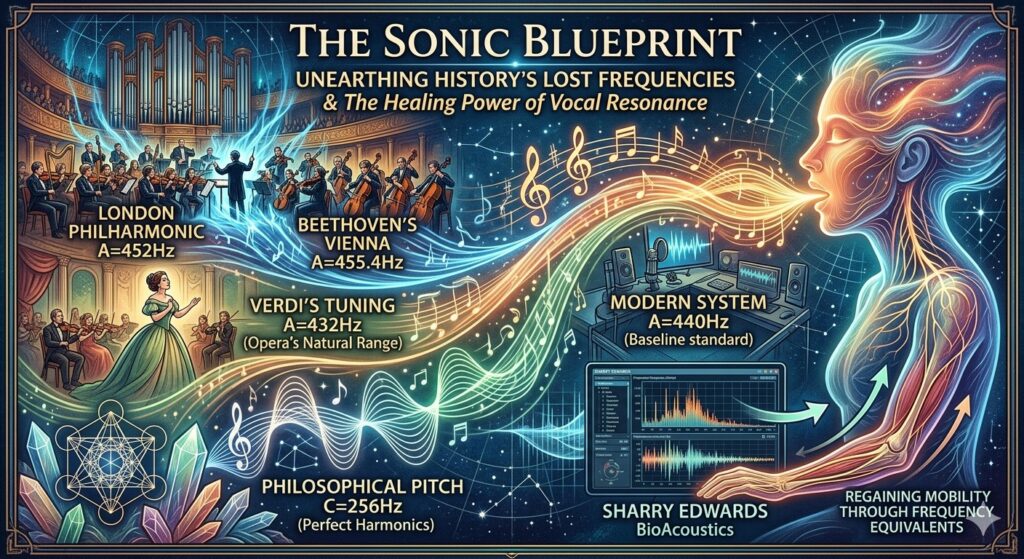
Toward the end of the 19th century, the British Royal Philharmonic tuned extraordinarily high, pushing A up to 450–452 Hz. This “Philharmonic Pitch” helped orchestras project through vast, crowded halls but became a nightmare for visiting opera singers. Vocalists suddenly had to reach notes nearly a semitone higher than originally intended, placing enormous strain on their voices.
Beethoven’s Vibrant Vienna (A = 455 Hz)
We often imagine classical music as warm, deep, and grounded. Yet Beethoven’s original tuning fork, preserved today in the British Library, reveals that his musical world was tuned to approximately 455.4 Hz. His music was performed with a bright, intense energy that would sound surprisingly urgent to modern ears.
The Refuge of Opera Singers and Verdi’s Pitch
As orchestras continued pushing pitch higher, singers pushed back.
Opera singers have long favored lower tuning because it allows the human voice to resonate naturally without excessive strain.
The great Italian composer Giuseppe Verdi became one of the leading advocates for a more singer-friendly standard. He was deeply concerned that orchestras were sacrificing vocal longevity for a temporary acoustic effect.
In 1884, Verdi supported the adoption of A=432 Hz as a standardized pitch. For those seeking a mathematically elegant system that also respected the human voice, this tuning seemed an ideal compromise.
Verdi described this frequency as giving music a “noble, full, and majestic” character. To this day, many opera enthusiasts and vocal purists regard 432 Hz as representing a golden age of natural singing. Quite simply, it makes singing easier.
The Mathematical Elegance of Scientific Pitch
This brings us to one of the most discussed mysteries in modern sound-healing circles: the connection to Scientific Pitch, historically known as Philosophical Pitch.
In 1713, French physicist Joseph Sauveur proposed a tuning system based entirely on the laws of nature and physics rather than the preferences of conductors. He argued that science should define our musical foundations and suggested setting middle C at exactly 256 Hz.
The Power of Two
Why 256 Hz?
Because 256 is a perfect power of two (2⁸).
If middle C is set at 256 Hz, every lower C octave becomes a neat whole number:
256, 128, 64, 32, 16, 8, 4, 2, 1.
Using the traditional Pythagorean tuning system and tuning upward from this mathematically elegant C, the note A naturally arrives at approximately 432 Hz.
But does mathematical beauty automatically make a frequency inherently superior?
Beyond the Numbers: The Essence of True Harmony
One of the most overlooked aspects of the tuning debate is that frequency values depend on the system we use to measure time.
A frequency of 432 Hz simply means 432 cycles per second.
Yet the second itself is a human-defined unit—not a law of nature.
Had humanity adopted a different system of timekeeping—such as the French decimal time system—every frequency number would be different, even though the actual sound would remain exactly the same.
This raises an important question:
How “sacred” can a number be if it changes when the unit of measurement changes?
This does not mean that one tuning cannot feel more harmonious than another. It simply means that the numerical value itself is not the ultimate source of harmony.
What remains constant across all systems are the relationships between frequencies—the ratios that create octaves, fifths, resonance, and musical coherence.
Rather than becoming attached to a specific number such as 432 Hz or 440 Hz, it may be wiser to focus on how music feels, how it influences consciousness, and whether it supports balance, well-being, and inner harmony.
After all, the human soul responds to vibration itself—not to the labels we assign to it.
Why Do Lower Frequencies Feel So Calming?
One possible reason is their relationship to our biology.
The average resting human heart beats approximately 60 times per minute, corresponding to a rhythm of roughly 1 Hz.
When we listen to music with slower tempos and deeper tonal qualities, something fascinating occurs: rhythmic entrainment.
Our internal biological rhythms begin to synchronize with external rhythms. Research suggests that lower frequencies and gentler pitches can help calm stress centers in the brain, support heart-rate regulation, and signal safety to the nervous system.
The message becomes:
“You are safe. You can let go.”
BioAcoustics: Decoding the Voice with Sharry Edwards
While the historical debate between 432 Hz and 440 Hz is fascinating, modern sound medicine takes the conversation a step further.
Increasingly, we are discovering that the human voice functions as a living holographic reflection of our physical, emotional, and mental well-being.
One remarkable example is the pioneering work of Sharry Edwards, founder of Human BioAcoustics.
Born with the unusual ability to perceive and reproduce micro-frequencies beyond the normal hearing range, she developed a system called Vocal Profiling.
Using specialized software to analyze a short recording of the speaking voice, her research suggests that certain vocal irregularities—or “missing notes”—may correlate with nutritional deficiencies, environmental toxins, or structural health challenges.
When I had my own voice analyzed, the note D repeatedly appeared as deficient. Interestingly, this is often observed in people born under the astrological sign of Gemini. Many of the themes associated with that note resonated strongly with areas of my life that deserved greater attention.
Restoring the Missing Frequencies
How are these imbalances addressed?
By identifying the missing vocal frequencies and reintroducing their corresponding frequency equivalents through low-frequency sound stimulation, the body receives an energetic blueprint for self-correction.
Documented case studies have reported remarkable outcomes, including individuals recovering arm mobility after severe motor impairments when conventional medical options had been exhausted.
The 440-Hz Bridge
One particularly interesting aspect of Sharry Edwards’ work is how it bridges the historical divide.
While many sound-healing practitioners reject the modern 440-Hz standard, Sharry performs her vocal analyses and frequency calculations using the current A=440 Hz reference.
Why?
Because our bodies have adapted to the acoustic environment in which we live. Modern human voices speak, sing, and resonate within today’s cultural soundscape.
By using 440 Hz as a stable diagnostic reference point, she meets the body where it is today and transforms ordinary acoustic measurements into powerful tools for regeneration and healing.
The Symphony of Life
Sound is not merely something we hear; it is part of the fundamental architecture of life itself.
Whether we tune our instruments to the brilliant heights of Beethoven’s Vienna or explore the subtle frequencies hidden within our own voices, we are participating in a vast symphonic dance.
Every note, every vibration, and every breath reminds us that we are part of a living universe woven together by resonance, rhythm, and consciousness.
Learn More
Embark with me on an adventure of the soul.
Train the extraordinary power of your thoughts—and especially the deeper and higher levels of your consciousness.
Discover and develop the innate ability of your mind to create and manifest what truly matters to you through these transformational courses.